PGConf India 2026
Sharing experience and learnings about my first profession conference.
Between: 12 March - 13 March
This was my first ever professional conference to attend. I was very excited for this, ever since my manager asked whether I wanted to go or not, since it helps me understanding how the community members/developers think and approach about the Postgres. And moreover, it would help me to gain knowledge and how fellow developers are gaining more insights about Postgres.
Talks I attended
A Deep Dive into SSL: Serializable Snapshot Isolation in Postgres
By Vaijayanthi Bharadwaj (EDB)
In this talk, the speaker explained how Serializable transactions work internally in PostgreSQL.
When a two concurrent transactions executed with Serializable Isolation, we can assume that the both transactions are executed in serial manner i.e one after the another.
Main Points:
Serializable Dependency Graph
RW Edge
WW Edge
WR Edge
Strict Two-phase Locking (S2PL): Algorithm to implement Serializability.
Serializable Xact: Per Transaction SSI State
Case Study: Understanding the importance of CommitLog through a Database corruption
By Amit Kumar Singh (EDB)
This talk was about how we can debug/understand a Database corruption issue using a commit log. And the speaker talks about his experience in debugging the core issue using various extensions and how important is to always upgrade your Postgres system whenever a minor version available.
Extension Discussed:
pg_inspect: Helps us to inspect the pages.
Can also helps to get tuple headers which can be helpful in identifying the corrupted tuples.
Tuple Headers:
HEAP_XMAX_INVALID
HEAP_XMIN_COMMITTED
HEAP_XMAX_INVALID
HEAP_XMIN_INVALID
HEAP_XMAX_INVALID
amcheck: To find the corrupted tables.
pg_surgery: provides various functions to perform a surgery on a relation like:
Marking a tuple dead with the help of heap_force_kill()
Marking a tuple freezed with the help of heap_force_freeze()
catcheck
pg_visibility
Ten Postgres Hacker Journey - and what they teach us
By Claire Giordano (Microsoft)
This talk was about top ten postgres hackers/committers/contributors and how they motivate themselves to code and contribute to Postgres Open Source.
Main Points:
Postgres Talking: A podcast hosted by the speaker. It can helps to any individual working on postgres whether they can be App Developer, DBA, Data Engineer, Contributors etc.
What are main 4 forces that shaped these hackers
Catalysts - How, Why, When?
Knowledge Inputs
Invisible Curriculum
Learning through Code.
pg_search: Bringing Elasticsearch-grade search to PostgreSQL
By Mithun C Yogendra (ParadeDB)
This talk was about the pg_search extension built for the postgres using Rust.
Main Points:
Scoring by BM25 Algorithm
Types of Indexes:
Inverted Index: Full-Text Search
Columnar Index: Agg, Filters etc..
What have built on top of postgres
Custom BM25 Index
Custom FTS Operators (|||, &&&, ===, ###)
Query Builder which converts FTS operations to PG understandable.
Where is my Memory?
By Phuskar Khadilkar, Mohit Agarwal (Google)
This talk was about how we can identify a potential memory leaks in postgres/postgres extension. And sometimes, how memory leaks can happen beyond the postgres that is memory leaks that postgres cannot identify by itself.
Main Points:
Explained how the memory allocated in shared buffers and how it store in OS and RAM.
Extensions:
pg_buffercache
pg_shmem_allocations
Tools:
memleak-bpfcc
flamegraph
For this talk, speaker injected a memory leak in the postgres by using mmap in a postgres extension. mmap is controlled by postgres so it don't have any idea about the memory allocated by it.
Understanding Locking and Concurrency in Postgres
By Pavan Deolasse (EDB)
This talks was about how the locking and concurrency works in Postgres. Speaker also talked about what locking provides, what problems we can face without locking, types of locks etc.
Main Points
Types of Locks
Spinlocks
LWLocks
HeavyWeight Locks
pg_locks extension
Lockable Objects
Relation
Tuple
Transaction ID
Extend
Object
Advisory
Lock Lifecycle
Table/Row Level Locks
Lock Manager Data structure
Some important things:
REINDEX Concurrently
DROP INDEX concurrently
NOT VALID constraint
Always setting lock_timeout before DDLs
End of Analyze Hell (Postgres 18)
By Rajkumar Raghuwanshi, Nishad Mankar (AWS)
This talk was about how pg_upgrade works in older PG versions compared to newer 18 version.
Main Points:
In older version, pg_upgrade will do the following things:
Copy Schema
Links/Copies Data files
Faster Upgrade
But it won't do transferring optimizer statistics, causing the queries in new upgraded system behaving differently then how they executed in older versions.
So we have to manually to ANALYZE or VACUUM to update the stats so that queries will be executed better.
From PG 18+ onwards, pg_upgrade will take care of transferring the optimizer stats as well there by removing one extra hop for the developers/DBAs.
Fun
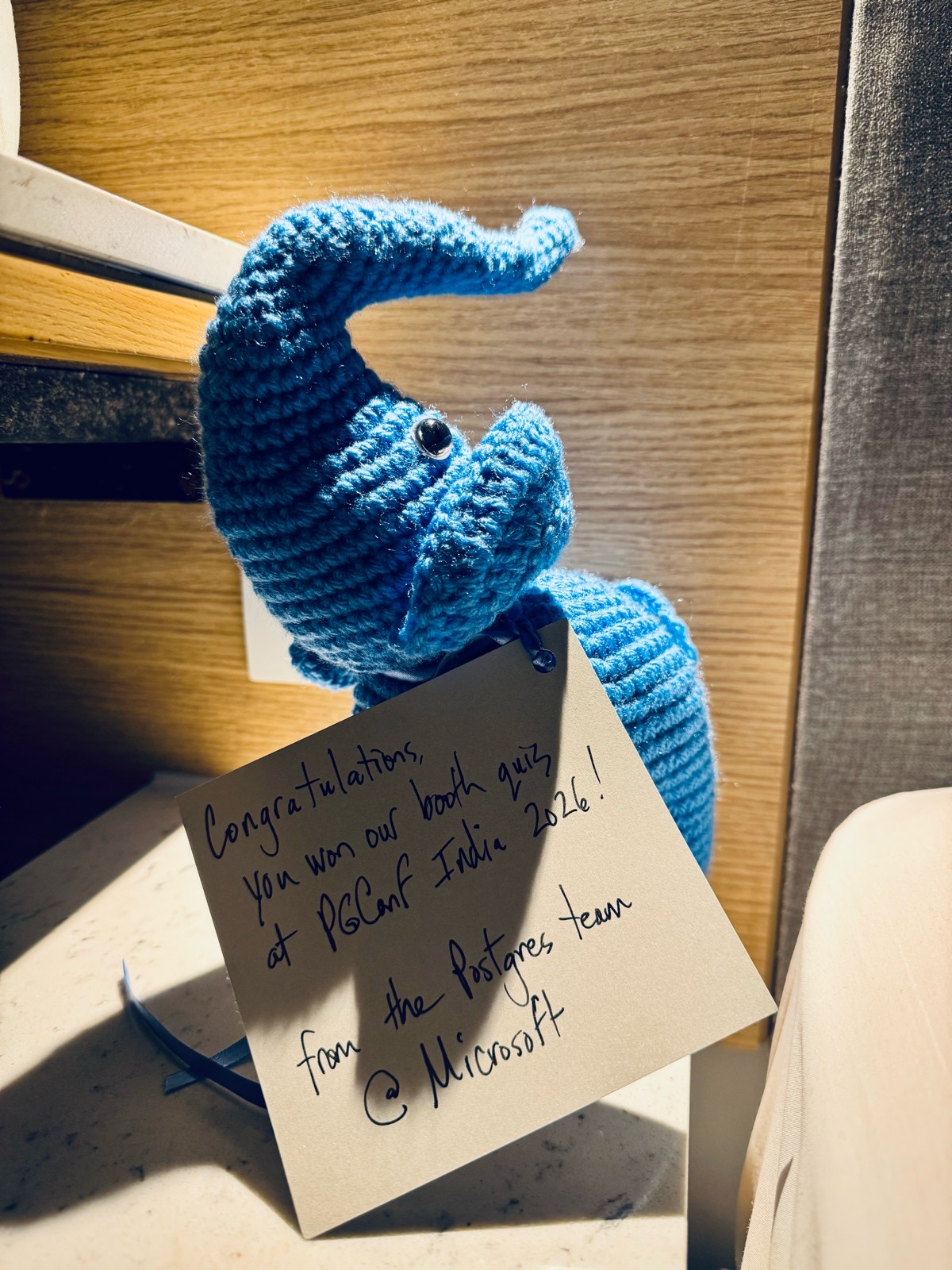
Initially I thought, the conference is always about networking, professional talks, technical discussions etc.. but in this conference there were also the quizzes conducted by the various companies. You may ask you said fun, but talking about the quizzes, but it is like technical fun.
Participated in every company's quizzes, won some, lost on last question for some, thrashed in some. But it was so amazing to see so many talented people and felt happy to compete against them.
Looking forward for the next year's PGConf!!
Enjoyed this post?
10 reactions
Related Posts
Comments
Leave a comment
Stay Updated
Get notified when I publish new articles. No spam, unsubscribe anytime.